added by Jean Miller , Ph.D. & & Sharon Hastings , Ed.D, addendum by TeachThought Staff
Just how around some mental health ideas for educators?
Today, the function of instructors is broadening to consist of more responsibilities and obligations than ever before, including building psychologically strong and healthy and balanced pupils.
However, culture commonly ignores to deal with or perhaps go over the mental and emotional well-being of instructors themselves. This neglect has actually caused 2 significant concerns– instructor burn-out and an absence of competent educators offered therefore.
See likewise 5 Blunders I Made As A Brand-new Instructor
Provided their increased duties, growing varieties of instructors are struggling to deal with the changing demands of their profession. According to a current survey of over 30, 000 instructors, performed by the American Federation of Educators, greater than 75 percent say they do not have sufficient team to get the work done, and 78 percent state they are often literally and emotionally exhausted at the end of the day.
The factor usually mentioned for leaving three-quarters of teachers feeling worn and exhausted was the adoption of new initiatives without correct training or professional development.
With regard to the labor force, not only did educator education and learning enrollment autumn by 240, 000 (a 35 percent decline) between 2009 and 2014 however about eight percent of teachers, including numerous that are well below the typical retirement age, leave the labor force every year.
One method to curb this exodus and maintain our country’s ideal educators in the classroom is to ensure they have the personal assistance and development they need to remain healthy and satisfied in both their individual and professional lives.
How To Assistance The Mental Wellness Of Teachers
According to a recent College of Phoenix survey on psychological health, virtually one-third (31 percent) of united state adults evaluated mentioned social preconceptions as a barrier to getting mental health care. This is an appropriate and frustrating figure for the education and learning market, as numerous teachers might likewise share the belief that seeking therapy signals weakness or a lack of ability to handle their work.
The truth is most of high-performing teachers have problem with the demands of their tasks; as a matter of fact, this battle triggers more than 50 percent of them to wear out in much less than five years. This stands as additional evidence that our sector experts have a vested interest in motivating educators to look for the help they require so they can be better and a lot more efficient in their functions.
To give our country’s instructors with the support they need, mental health resources like specialized counseling, proceeding education programs, and area efforts geared towards health must be prioritized.
By making mental health care extra quickly available to educators, we can help them move on as experts and individuals while making strides to get rid of the stigma usually related to seeking psychological wellness treatment.
A couple of other mental wellness tips for instructors?
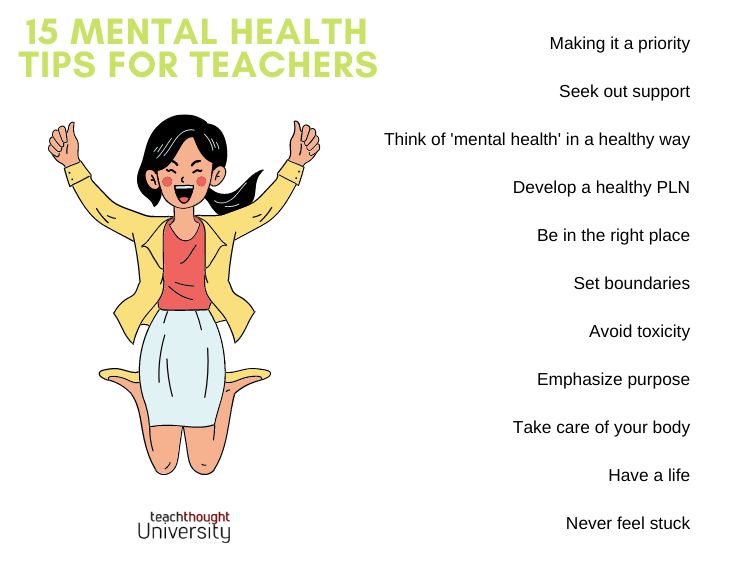
15 Mental Wellness Tips For Educators
1 Make it a psychological wellness top priority
First and foremost, mental wellness and wellness finest techniques should be incorporated into training programs beforehand in educator education and learning. It depends on college and state accreditation boards to take the lead in developing these programs, to make sure that psychological health and wellness ends up being a concern in our schools which all educators are offered the resources they require to succeed and stay healthy and balanced.
There’s a factor great instructors gave up
2 Choose or establish sources, programs, and plans
District leaders likewise have a role to play in developing mental wellness and health societies in institutions across the country. As a second step, college systems require to invest in the mental, physical, and social health of their most valuable possession– their teachers. By recognizing and awarding educators for all that they do (also the ‘little’ points), motivating the use of small groups and therapy, and prioritizing psychological health, administrators can have a significant, favorable influence on the lives of their teachers.
3 Mount ‘psychological wellness’ in your very own mind in a healthy way
Don’t call it ‘psychological health’ if a phrase like ‘wellness’ makes more feeling.
4 Grow a healthy PLN
A strong specialist understanding network — both inside and outside of the institution structure.
5 Be in the right area
A work placement that they feel comfy with– i.e., the ‘ideal’ suitable for the educator in terms of position, quality level, college policies, etc. Not every work is a fit for every person. Well-intentioned individuals might advice you that the ‘youngsters require you,’ however you have to deal with on your own or your training’s simply not lasting.
6 Set borders
As much as feasible, clear borders in between institution and home life.
7 Stay clear of poisoning
Evasion of points– individuals, departments, committees, occasions, and so on– that are ‘harmful’ while creating methods to manage various other not-toxic-but-still-challenging training circumstances
8 Highlight your objective
Advise on your own of your purpose as an instructor– why you ended up being a teacher. If you’re not able to understand that vision, see if you can fix up that vision with your prompt circumstance. Otherwise, that offers you a hint of what perhaps must follow.
9 Establish a growth attitude as an educator
Development mindsets issue for students and they matter for instructors, also.
10 Show with thankfulness
Instruct with gratefulness as high as possible.
11 If you’re able, begin little
Concentrate on the good things and every day, attempt to have more good ideas than negative. (That’s a start.)
12 Take care of your body, too
Deal with yourself literally: workout, meditate, do yoga, obtain sufficient sleep, and so on. Whatever it takes for your body to feel great.
13 If you need assistance, get aid
Do not be a hero. If you need official mental wellness assistance (in the form of therapy or medication), there’s no reason to think twice. Get it. Why wait until you’re genuinely miserable?
14 Have a life beyond training
Have a life beyond mentor– one filled with creative thinking and hope and people and possibility. Despite just how nobile mentor is, it’s unworthy your health.
15 Do not really feel stuck
Preferably, never ever get ‘stuck’ where you feel like you ‘need to’ educate or ‘can not give up.’ There’s constantly a method ahead. Anytime any individual feels ‘stuck,’ it can encourage you your situation is even worse than it actually is.
Educators are functioning each day to build emotionally strong and healthy youngsters, molding the future generation of leaders and change-makers. As instructors’ responsibilities continue to expand at a quick rate, we have to do all we can to support their mental health. We need to support the ‘whole instructor.’
By offering the emotional support our teachers so seriously need and should have, we can aid them grow properly and live happier lives all while combating the educator shortage in America that is placing a pressure on the whole education and learning system.
Dr. Jean Miller is the University’s Denver University University Chair, and Dr. Sharon Hastings is the clinical director and supervisor of the Counseling Facility at University of Phoenix Metro; Expanding The Whole Educator: Mental Health And Wellness In Education ; 13 Mental Wellness Tips For Educators